Environmental Science & Policy, B.S.
The interdisciplinary environmental science and policy major is designed to promote undergraduate student understanding about environmental issues and to enable you to make meaningful contributions toward the management of the world’s natural resources.
The major focuses on conservation education through coursework in natural and social sciences with emphasis on student research, case-study and project-based learning.
Two Program Tracks
- Science track
Focus your study on the environmental and conservation issues from the perspective of the natural sciences, complemented by course work in economics and policy - Policy track
Take a comprehensive approach to the study of environmental and conservation policy issues and processes, complemented by course work in the natural sciences.
Learning Outside the Classroom
From plant identification and measuring water quality to calculating land values and mapping trails, students studying environmental science and policy have opportunities to learn and gain experience outside of the classroom.
Outdoor classroom activities and field experiences are planned throughout each academic year. You will travel to lakes, forests and mountainous areas to perform a variety of ecological studies and experiments. You also take an active role in nature preservation on campus.
-
Research, Internships & Study Abroad
Students are required to complete an independent research project - performing all aspects of scientific discovery from data collection and observation to experimentation and evaluation – and present their findings to faculty and peers.
Internships and study abroad field and research experiences are also strongly encouraged through the environmental science and policy major.
-
Student Activities
The College of of Natural Science and Mathematics hosts the Steelman Lecture Series through which renowned scientists and scientific writers are invited to speak to the campus and surrounding community.
Career and graduates school nights are also held annually. These events feature former students and respected professionals in the field who speak with current students, offering information and guidance about various career options.
Career Opportunities
-
Science Track
Students graduating through the science track are prepared for jobs in environmental organizations, government agencies, and education and recreation programs. Graduates are in demand for consulting firms that conduct environmental analyses through field data collection and laboratory analysis.
Government and private property owners also need managers for their lands, parks, and natural resources. Other opportunities included environmental monitoring, regulation, landscape and tree care or environmental restoration.
With a strong scientific and technical background in natural resources, you may choose to continue you studies in graduate school in a wide range of fields such as conservation biology, forest management, environmental law and ecology.
-
Policy Track
Graduates of the policy track are well-equipped for jobs in environmental organizations, government agencies, education and recreation programs. Natural resource policy specialists are needed by public planning departments, consulting firms, environmental non-profits and natural resource agencies.
Graduates may choose to work in environmental preservation, public policy analysis and policy-making, natural resource management, city planning or resource economic analysis.
Equipped with a broad background in government, economics, and policy make graduates competitive candidates for graduate school in many fields including natural resource policy, environmental economics, public administration and environmental law.
Major Requirements
Lenoir-Rhyne University's Environmental Science and Policy major offers an interdisciplinary approach to understanding and addressing today's most pressing environmental challenges. This program equips students with the scientific knowledge, policy insight and practical skills needed to contribute meaningfully to the conservation and sustainable management of natural resources. Rooted in both the natural and social sciences, the curriculum emphasizes experiential learning through research, case studies and project-based coursework. Students explore topics such as ecology, environmental policy, climate change, conservation biology and environmental ethics, while also developing analytical and communication skills critical to effective environmental leadership. The program offers two distinct tracks-Science and Policy-allowing students to tailor their education based on their interests and career goals. Internships and field-based learning, including study abroad opportunities, are strongly encouraged to enhance classroom learning and prepare students for real-world impact. Graduates are well-prepared for careers in environmental consulting, natural resource management, sustainability planning, environmental education, nonprofit advocacy or for advanced study in related fields.
-
General Education Requirements (37 hours)
Graduation Requirements (4 hours)
-
Technical Requirements (17-18 hours)
- BIO 121 - Principles of Biology I
- ECO 122 - Principles of Economics Microeconomics
- POL 120 - American Politics and Government
Choose one math course:Choose one statistics course: -
Major Requirements (54-56 hours)
- BIO 122 - Principles of Biology II
- BIO 310 - General Ecology
- ECO 262 - Economics of the Environment
- EAR 110 - Physical Geology
- ENV 120 - Introduction to Environmental Science and Policy
- ENV 200 - Environmental Seminar
- ENV 231 - Environmental Policy
- ENV 250 - Introduction to GIS
- ENV 250L - Introduction to GIS Lab
- ENV 325 - Environmental Monitoring
- PHI 251 - Environmental Ethics
Choose one of the following options:- Option 1 (4 hours):
- ENV 470 - Problems in Environmental Science and Policy
- Option 2 (6 hours)
- ENV 498 - Senior Honors Researchand
- ENV 499 - Senior Thesis
Choose one course:Choose 12 hours from one Track below:Policy TrackScience TrackChoose 4 hours from this list and then one 8-hour physics sequence below
- BIO 212 - Biology of Microorganisms
- BIO 260 - Natural History and Field Biology
- CHE 103 - General Chemistry and Qualitative Analysis I
- CHE 103L - General Chemistry and Qualitative Analysis Laboratory I
- CHE 104 - General Chemistry and Qualitative Analysis II
- CHE 104L - General Chemistry and Qualitative Analysis Laboratory II
- CHE 201 - Organic Chemistry
- CHE 202 - Organic Chemistry
- EAR 210 - Climatology and Meteorology
- EAR 240 - Map Construction and Reading
- ENV 210 - Environmental Education I
- ENV 215 - Environmental Education II
Choose one 8-hour physics sequence -
General Elective Credits
General Electives (5-8 hours) as needed to reach 120 hours overall.
-
Total Credit Hours - Minimum 120 hours
On occasion, technical and/or program requirements may also meet specific General Education requirements. Please confer with your program advisor to determine which courses, if any, may be counted accordingly.
All bachelor's degree programs at Lenoir-Rhyne require at least 120 credit hours. If, in combination, General Education, technical, and program requirements do not generate at least 120 hours, additional credits must be completed to achieve 120 hours. These classes may be general electives, or a student may complete a minor or additional major.
News & Events
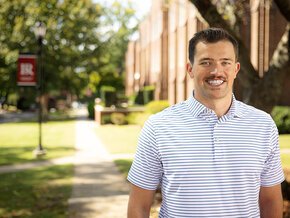
Meet the student leader working to make LR's Student Government Association more accessible — and learn his strong opinions on Oreos, Darius Rucker and teleportation.
View More
Lenoir-Rhyne welcomes alumni and friends back to campus Oct. 16–17 for Homecoming 2026, featuring milestone reunions, favorite traditions, the Eastside Commons groundbreaking and Bears football.
View More