The First Arrival
Remembering Agnes Park, class of 1924, LR's trailblazing international student, a century later.
The train rattled eastward, its windows framing an endless sweep of prairie. Towns flickered past in a scatter of grain silos and church steeples, then gave way again to fields rolling out beneath the sky. Every mile carried her deeper into a country she had never seen — deserts where the air shimmered, mountains lifting sharp against the horizon, rivers flashing silver in the sun. She slept upright in her seat, lulled by the steady rhythm of the rails, waking to landscapes that shifted with each dawn.
The journey had begun at sea. The steamship pulled away from Honolulu Harbor with its decks crowded and bunks below close and plain, six days of open water stretching between the islands and the mainland. The air smelled of salt and coal smoke, the ship rolling steady as the days stretched on. For nearly a week there was nothing but ocean, until the coastline of California rose into view. From there, the long overland passage led toward the Blue Ridge Mountains, where she would make her new home.
Her name was Agnes Myung Sool Park. This wasn’t her first long journey. Years earlier, she had crossed the Pacific with her family, part of the first wave of Korean immigrants to Hawaii in 1904. Park and her sister Ethel came with their parents from Seoul; their mother had been a seamstress in the Korean royal court, which may have influenced the family’s decision to leave.
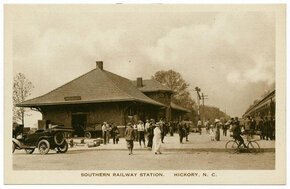
After arriving in Hawaii, the Parks had three more children, bringing Agnes’ total number of siblings to four. From 1904 to 1911, the Parks worked on plantations on Hawaii and Kauai. In 1911 they moved to Honolulu, where they ran a boarding house near the Oahu Railway and Land Company (OR&L) depot. This new journey — traveling alone to the mainland for college — would be unlike any she had undertaken before.
While Park would become the first international student to attend Lenoir-Rhyne College, her path to higher education began at Elizabeth College, a Lutheran women’s college that had moved from Charlotte, North Carolina, to Salem, Virginia, when it merged with Roanoke College for Women in 1915. The school promised “a broad and liberal culture for women” through study of the classics, mathematics, and sciences. Then in 1921, disaster struck: a fire destroyed the Virginia campus, and most of Elizabeth College’s records were lost. By 1922, Park transferred to Lenoir-Rhyne, another Lutheran college connected to the Blue Ridge. She graduated in 1924 with a bachelor’s degree in science.
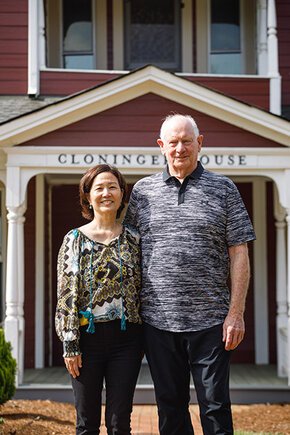
“In Hawaii at that time, it was unusual for the children of laborers to go to college, but education was very important to my grandmother's family and throughout the immigrant community,” shared Karen Higo, Park’s granddaughter, who visited the Lenoir-Rhyne campus in spring 2025 along with her husband, Jim Wagoner. “It was also unusual for her to travel so far away for college. People from Hawaii tend to stay in Hawaii. I'm proud my grandmother had the courage to travel so far in her early 20s.”
Higo acknowledged the historical record is thin on details regarding how and why her grandmother ended up in North Carolina. In 1923, the Salisbury Post described Park as a Methodist who spoke five languages and noted that she worked her way through college with support from local Methodist and Lutheran churches and Sunday school classes. Taken together, these details place Park’s’ story within a broader history in which churches helped provide higher education opportunities for children of immigrant workers in Hawaii as part of Protestant missionary work during the early 20th century.
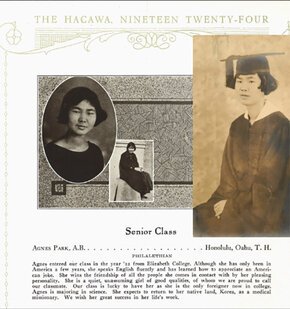
Higo was inspired to visit Lenoir-Rhyne after discovering her grandmother’s 1924 Hacawa yearbook a little over a decade ago. “I’ve been thinking about making this trip for a long time. Her yearbook is a very typical yearbook – it’s very positive, but there were just pages and pages of autographs. I wanted to see firsthand where she built this life for herself, to walk the same paths she walked.”
In her yearbook, some of the language is antiquated, but the warmth and regard Park’s classmates felt for her are obvious: “Although she has only been in America for a few years, she speaks English fluently and has learned how to appreciate an American joke. She wins the friendship of all the people she comes in contact with by her pleasing personality. She is a quiet, unassuming girl of whom we are lucky to call her classmate.”
One of the signatures filling the yearbook pages came from Voight Cromer, a member of the Class of 1925 who would later serve as Lenoir-Rhyne’s president and for whom the student center is named: “Wherever you may be, you have my best wishes.”
Notes from Park's closer friends offered a different, more intimate window into her life on campus. Her roommate’s entry opens with the type of sarcasm typical among close friends: “You lazy, crazy, good-for-nothin’ child, get up right this minute! Don’t you know you have an eight o’clock class?” The note goes on to hint at memories of a broken curfew and some last-day-of-semester hijinks. Signing off as “your lovin’ roommate,” the name below seems to be a nickname or inside joke rather than a formal name. These glimpses reveal Park’s sense of humor and mischievous streak — suggesting she felt safe and secure on campus, whatever the broader climate might have been like in the area for a young Asian woman.
On her visit to campus, Higo retraced her grandmother’s steps, though much has changed since 1924. Park had been a resident of Oakview, the women’s dorm at the time, housing roughly 40 students. Both Oakview and Old Main — another significant building from Park’s era — were destroyed by fires in 1935 and 1928, respectively, so visitors today see only the sites and commemorative markers.
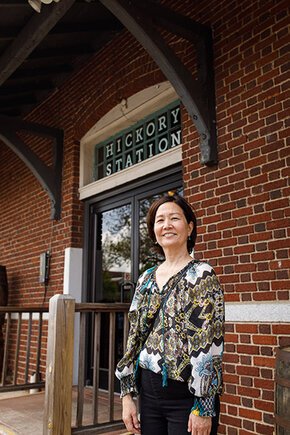
“I’m impressed with the campus,” said Higo. “The buildings are newer than my grandmother’s time here, but the tour builds a picture of what life would have been like for her then — very formal, very ‘ladies and gentlemen.’ I’m just overjoyed to be here to imagine what that was like.”
Life at Lenoir-Rhyne in the 1920s was structured but full of camaraderie. Students lived in modest dormitories, attended classes in the sciences and liberal arts, and participated in literary societies, church services and informal walks along campus driveways — all under rules designed to maintain decorum, especially for women. It’s clear Park formed close bonds with her friends at Lenoir-Rhyne, though given the limitations of communication in the 1920s and 1930s, it’s unclear how much contact she maintained after graduation. Overall, her social life appears to have mostly conformed to the rules in place at the time.
Park received a moderate press attention during her two years at LR. In November 1922, the Hickory Daily Record reported that she and a Japanese student, H. Kirai, spoke at Corinth Reformed Church, describing their talks as “very interesting.” Higo also observed these speeches took place in a tense historical context, as Japan was in occupation of Korea throughout the 1920s.
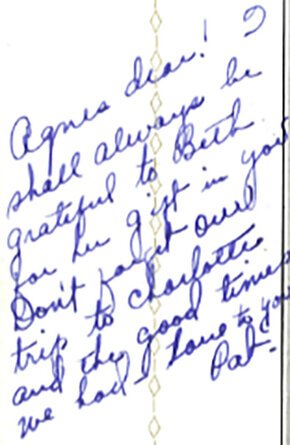
A few months after the Corinth talks, Park appeared in a comedic role in the junior class play “Much Ado About Betty,” and that summer she remained on campus to attend summer school. In 1923, the Salisbury Post covered her holiday visit to a friend from LR and noted her plans to return to Korea as a missionary after graduation.
“As unusual as her college experience was, I think it was a very positive experience for her,” Higo said over a post-tour lunch at the Hickory Station — a local restaurant housed in the same building where Agnes Park would have arrived in Hickory for the first time more than a century earlier. “She was so independent, starting with moving countries as a small child, and she and my grandfather traveled extensively.”
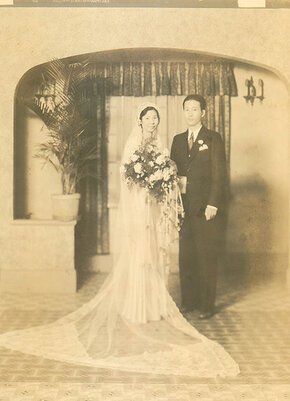
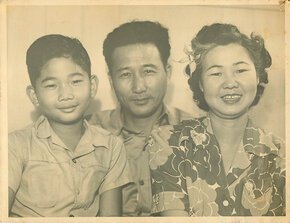
After college, Park returned to Hawaii and worked as a stenographer, where she met Moon Sung Chung, who had returned to the islands after graduating from Oberlin College in 1926. They married in 1933, and their son Donald was born in 1934. During World War II, Chung served in the Pacific theater as a radio technician, while Park remained in Hawaii caring for Donald. After the war, Chung’s work for the Civil Aviation Authority took him throughout the South Pacific — Guam, Canton Island, Wake Island and Kwajelin — before Park joined him in 1950 on Canton Island, where she taught school. The couple became U.S. citizens in 1949 and retired in 1962.
“I see my grandparents' motivation to move around and do their own thing in myself and in my father," Higo shared. "I've lost count of how many moves that yearbook has been through in the last hundred years — from Hawaii to California to Connecticut to New York, just in the time I've had it. Holding it here brings her story, and the history of Lenoir-Rhyne, vividly to life. I'm here to celebrate her courage and her remarkable accomplishments.”
News & Events
Lenoir-Rhyne welcomes alumni and friends back to campus Oct. 16–17 for Homecoming 2026, featuring milestone reunions, favorite traditions, the Eastside Commons groundbreaking and Bears football.
View More
After a successful 2026 launch season, LR’s rocket team is building toward a new competition — and aiming even higher in 2027.
View More