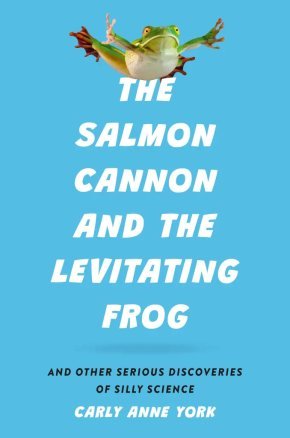
LR biology professor’s “The Salmon Cannon and the Levitating Frog” named a “Top Read of 2025”
Salmon don’t usually fly — unless they’re launched from a giant pneumatic tube shooting them over hydroelectric dams in the Pacific Northwest. Engineers built the so-called “salmon cannon” to help migrating fish reach their spawning grounds and preserve endangered populations. It’s the kind of strange but ingenious solution that can be found in Lenoir-Rhyne biology professor Carly Anne York’s new book, “The Salmon Cannon and the Levitating Frog,” named one of Science News’ “Top Reads of 2025.”
“I feel incredibly honored that Science News magazine included ‘The Salmon Cannon and the Levitating Frog’ among their favorite books of 2025,” said York. “When I’m writing a book like this, I’m completely immersed in the research and storytelling. You never know how it will resonate once it’s released into the world. Recognition like this is deeply meaningful. It affirms that the work connects, that others find value in these stories and that what I have to say matters.”
Founded in 1921, Science News is among the country’s most longstanding and respected science journalism outlets. The publication is known for its independence and trusted by educators, researchers and the general public.
Published in June by Hachette Book Group, “The Salmon Cannon and the Levitating Frog” explores what York calls “silly science” — research driven purely by curiosity, often without an immediate practical application in mind. From questions about how fast a mantis shrimp can punch to why wombats produce cube-shaped scat, the book celebrates the playful, surprising paths that scientific inquiry can take.
“Curiosity-driven research can lead us places we never imagined,” York said. “A lot of time people say, ‘Why are you doing this?’ or ‘Why should we put money into science?’ But history shows that some of the biggest leaps forward started with someone asking a question just because they wanted to understand the world better.”

For example, the levitating frog is the result of Andre Geim’s experimentation with a magnet strong enough to raise water droplets and organic materials into the air. At his wife’s suggestion, he ended up using the magnets to lift a live frog, which earned him an Ig Nobel Prize in 2000. Then in 2010, Geim won the Nobel Prize in Physics for foundational work on graphene – an incredibly strong material that is only one atom thick. He remains the only person to receive both honors.
Stories like this one and the others collected in York’s book make science more accessible and pique public interest.
“When you start with something playful — a shrimp that punches harder than a heavyweight boxer or a worm that ties itself in knots — suddenly people lean in,” she said. “They’re curious. They’re laughing. And from there, it’s much easier to show how science works. Those questions become the doorway to deeper understanding.”
Since the book’s release, York has appeared on CNN, PBS, NBC News and podcasts including Discovery Channel’s Curiosity Weekly, Popular Science and Talk Nerdy, bringing LR science and LR students’ curiosity to a national audience.
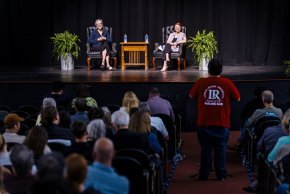
York’s favorite interview was with Alan Alda – the Emmy-winning actor and longtime advocate for clear, engaging science communication. Alda hosts the Clear and Vivid podcast.
“It was an honor to speak with someone who has led such a remarkable, influential life,” York said. “Alan has interviewed many of my own science-writing heroes like Mary Roach and Ed Yong, as well as cultural icons including Paul McCartney, Michael J. Fox and Tom Hanks. It felt truly special to sit in that same virtual ‘seat.’”
At the heart of the book lies a message about why curiosity matters — both in research and in public understanding of science.
“Curiosity-driven research isn’t a luxury,” she said. “It’s a foundation. When people meet the stories and the scientists behind the discoveries, science becomes human and relatable again. That’s how we build trust — through clear stories, honest questions and a willingness to wonder.”
News & Events
Meet the student leader working to make LR's Student Government Association more accessible — and learn his strong opinions on Oreos, Darius Rucker and teleportation.
View More
Lenoir-Rhyne welcomes alumni and friends back to campus Oct. 16–17 for Homecoming 2026, featuring milestone reunions, favorite traditions, the Eastside Commons groundbreaking and Bears football.
View More